
At the close of a year-long executive team coaching program, the CEO paused and asked me:
“If there’s one thing you’d suggest we keep doing to help us to continue to operate as a high performing team, what is it?”
Before offering my view, I invited the team to first reflect on the CEO’s question. Over half independently identified the same opportunity – to embed what I call, the Pathway to Flourish.
It’s not a strategy.
It’s not a restructure.
It’s not a capability framework.
Rather it’s a conversational discipline.
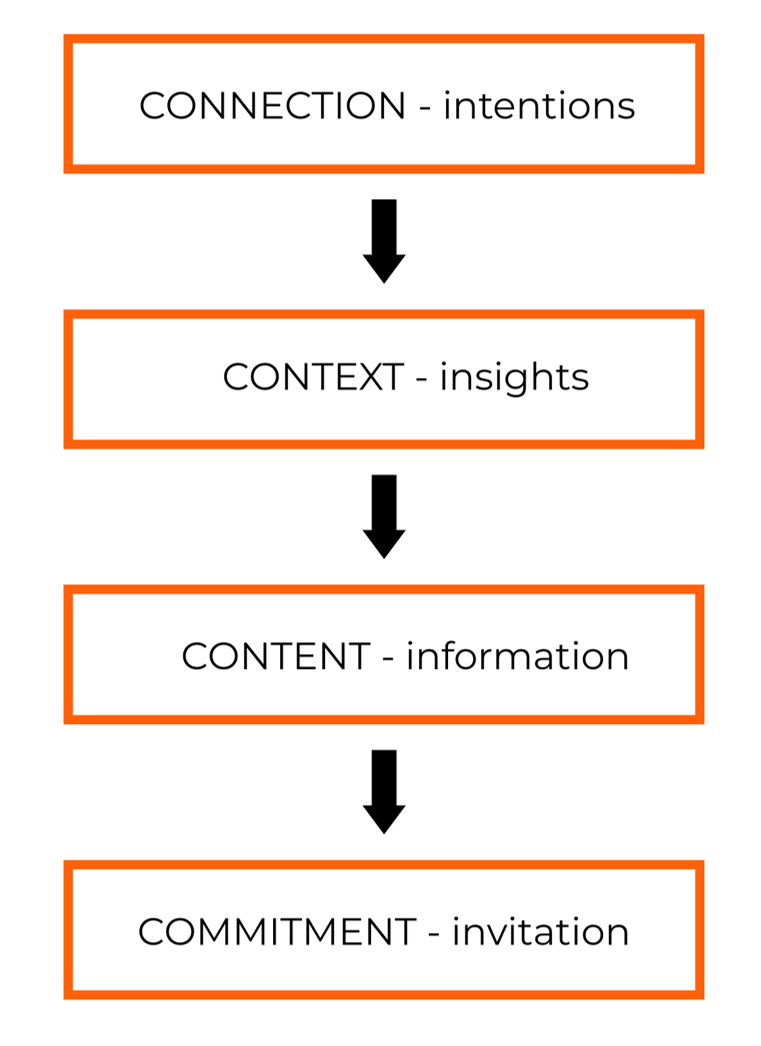
The Pathway to Flourish is intended to enable teams to build trust, discuss the undiscussables, and ensure alignment.
The sequence to the Pathway includes: connection, context, content. commitment.
In more than a decade of coaching executive teams, I’ve observed a recurring pattern when teams begin to flounder. Breakdowns rarely begin with disagreement; they begin with assumed intent, missing context and unspoken concerns.
When intent is unclear and context absent, resistance builds, safety drops, and truth is compromised. Floundering teams start debating content without understanding intention. They challenge data without appreciating perspective. Consequently, they leave meetings appearing committed but personally disengaged.
The Pathway to Flourish
High-performing teams follow this simple and empowering conversational sequence:
1. CONNECTION — declare intent
The greatest enemy of trust is assumed intent. Flourishing teams do not leave intention to interpretation; they declare it. By declaring their intentions, they clarify:
What outcome they intend to seek.
How the outcome serves the parties’/team’s/organisation’s interest?
When intent is declared and framed in the mutual interest of the parties, connection is possible. Connection precedes persuasion.
2. CONTEXT — share insights
Before content, there must be context.
Why this?
Why now?
Why does it matter?
Context answers the unspoken question in every person’s mind: “Why should I care?” When leaders share the thinking behind their thinking (context), they make it easier for others to engage meaningfully. The quality of context determines the receptivity to content.
Without context, information feels arbitrary. With context, it feels purposeful.
3. CONTENT — new information offered
Only once intent is trusted and context understood does content become relevant and helpful. This is where ideas are robustly tested and assumptions are surfaced and where differences are safely and openly explored. In flourishing teams, everything is discussable.
Content without connection creates conflict. Content after connection creates safety.
4. COMMITMENT — invite call to action
Finally, clarity is provided to who will do what, by when, and in service of the declared intention. Too many conversations end in vague agreement and confused commitment. Flourishing teams close the loop. They convert content into explicit commitments.
When intent is shared, context understood, and perspectives shared and heard, commitment becomes a natural extension rather than a forced compromise.
INVITATION
At your next executive team meeting, notice the order of the conversation:
Are you beginning with data or with a declared intent?
Are you offering content without context?
Are commitments explicit or assumed?
If performance feels hard to build or maintain, avoid first questioning the strategy. First, listen to the sequence of your conversations.
When the team consistently moves through Connection → Context → Content → Commitment, undiscussables become discussable, alignment strengthens and momentum builds.
Remember, conversations shape relationships. Relationships shape results.
May you flourish.